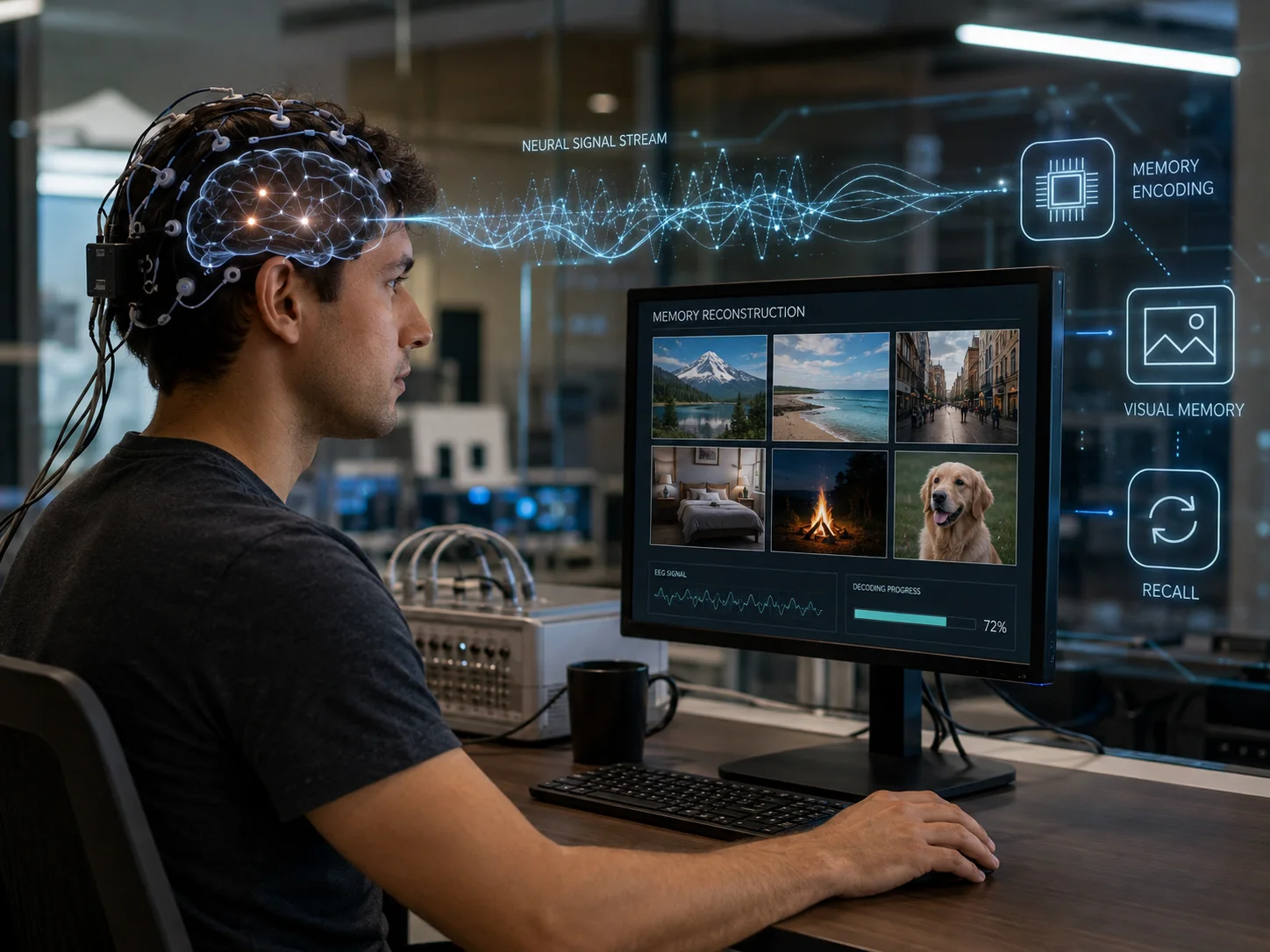
Human memory is one of the most fascinating—and mysterious—functions of the brain.
Every day, we see thousands of faces, objects, places and moments. Some remain with us for years, while others disappear almost immediately.
Why does the brain preserve one experience but forget another?
At NeuroTech, our long-term vision is to explore whether information associated with human memories can eventually be captured, interpreted, preserved and retrieved using technology.
But we cannot begin by trying to “download” an entire memory.
We must first understand whether measurable brain activity contains clues about how memories are formed.
That leads us to our first major research question:
Can non-invasive brain signals help predict whether a person will later remember or forget visual information?
What does this question mean?
When a person looks at a photograph, the brain processes several things at once:
- The visual features of the image
- Whether it appears familiar
- The emotional response it creates
- How much attention the person gives it
- Whether the brain successfully stores information about it
Some experiences are strongly encoded into memory. Others are processed only briefly and later forgotten.
Our goal is to investigate whether brain signals recorded during the moment an image is viewed contain patterns associated with successful memory formation.
We are not trying to read someone’s private thoughts.
We are not attempting to extract a complete memory as a photograph or video.
The first objective is much more focused:
Can a computer analyse brain activity and estimate whether the person is likely to remember a particular image later?
Why start with visual information?
Images provide a controlled and practical starting point.
During an experiment, we can display a known set of photographs and record:
- Which image appeared
- The exact time it appeared
- How long it remained visible
- The participant’s brain activity
- Whether the participant later recognised it
- How confident the participant was
This creates clearly labelled information that can be analysed scientifically.
For example:
Image 01 — Remembered
Image 02 — Forgotten
Image 03 — Remembered
Image 04 — Uncertain
We can then compare the brain activity recorded during remembered images with the activity recorded during forgotten ones.
Our proposed first experiment
The first experiment will be known as:
NT-EXP-001: Predicting Visual Memory Encoding Using EEG
The participant will view a controlled collection of images while brain activity is recorded using non-invasive electroencephalography, commonly known as EEG.
The experiment will follow five main stages.
1. Visual presentation
A series of images will appear individually on a screen.
Each presentation will be timestamped so that the image can later be matched with the corresponding brain-signal segment.
2. Brain-signal recording
EEG sensors placed on the scalp will record electrical activity generated by the brain.
The process is non-invasive and does not involve surgery, implants or brain stimulation.
3. Distraction period
After viewing the images, the participant will complete a short unrelated activity.
This helps prevent them from simply holding all the images in immediate working memory.
4. Memory test
The participant will see a mixture of previously presented and unfamiliar images.
They will indicate whether they remember each one and how confident they are.
5. Data analysis
Every image will receive a result such as:
- Remembered
- Forgotten
- Uncertain
Artificial intelligence and statistical models will then analyse whether patterns in the recorded EEG signals are associated with those results.
What would count as success?
Success would not mean that we have downloaded a memory.
It would mean that a model performs better than random guessing when predicting whether a visual item will later be remembered.
The strongest result would be a pattern that remains useful across:
- Different recording sessions
- Different days
- Different collections of images
- Eventually, different participants
We must also compare the brain-signal model against simpler explanations.
For example, perhaps a person remembers brighter or more emotional images more easily. The model must demonstrate that the neural signals add useful information beyond the characteristics of the images themselves.
Why this matters
If brain activity can provide reliable information about memory formation, it may become one building block for more advanced systems.
Future research could investigate whether neural signals can help:
- Detect when learning is likely to succeed
- Identify strong and weak memory encoding
- Improve personalised learning systems
- Search a digital memory archive
- Recognise broad memory categories
- Support people experiencing memory difficulties
- Connect digital life records with neural responses
Each of these possibilities requires careful research, strong privacy safeguards and scientific validation.
What this experiment will not prove
Even a successful result would not mean that a device can see exactly what someone remembers.
EEG signals are complex, noisy and affected by many factors, including:
- Attention
- Fatigue
- Movement
- Blinking
- Stress
- Sleep
- Motivation
- Electrical interference
A prediction may also be wrong.
That is why every result must include limitations, confidence levels and clear explanations of what the technology can and cannot do.
Our first practical step
We will begin by working with existing public EEG datasets and simulated experiment data.
This will allow us to build and test:
- The signal-processing pipeline
- Data-cleaning procedures
- Visualisation tools
- Memory classification models
- Experiment documentation
- Accuracy and validation methods
Once the software pipeline is working reliably, we can prepare our own non-invasive recording setup.
Any formal research involving participants will require informed consent, appropriate scientific oversight and ethical approval.
Building in public
NeuroTech will document this journey openly.
We will publish:
- Experiment designs
- Technical architecture
- Lessons and failures
- Signal visualisations
- Model results
- Ethical questions
- Research limitations
- Community contributions
We believe that ambitious technology should not be built behind exaggerated claims.
It should be built through transparent experiments, careful measurement and collaboration.
Contribute to the project
We welcome ideas from:
- Neuroscientists
- Psychologists
- Software engineers
- Artificial-intelligence researchers
- Biomedical engineers
- Students
- Ethicists
- Designers
- Curious members of the public
You can contribute by helping us improve the experiment, identify risks, recommend datasets, challenge assumptions or propose better research questions.
This is only the beginning.
Before we can preserve a memory, we must first understand the signals that accompany its formation.